
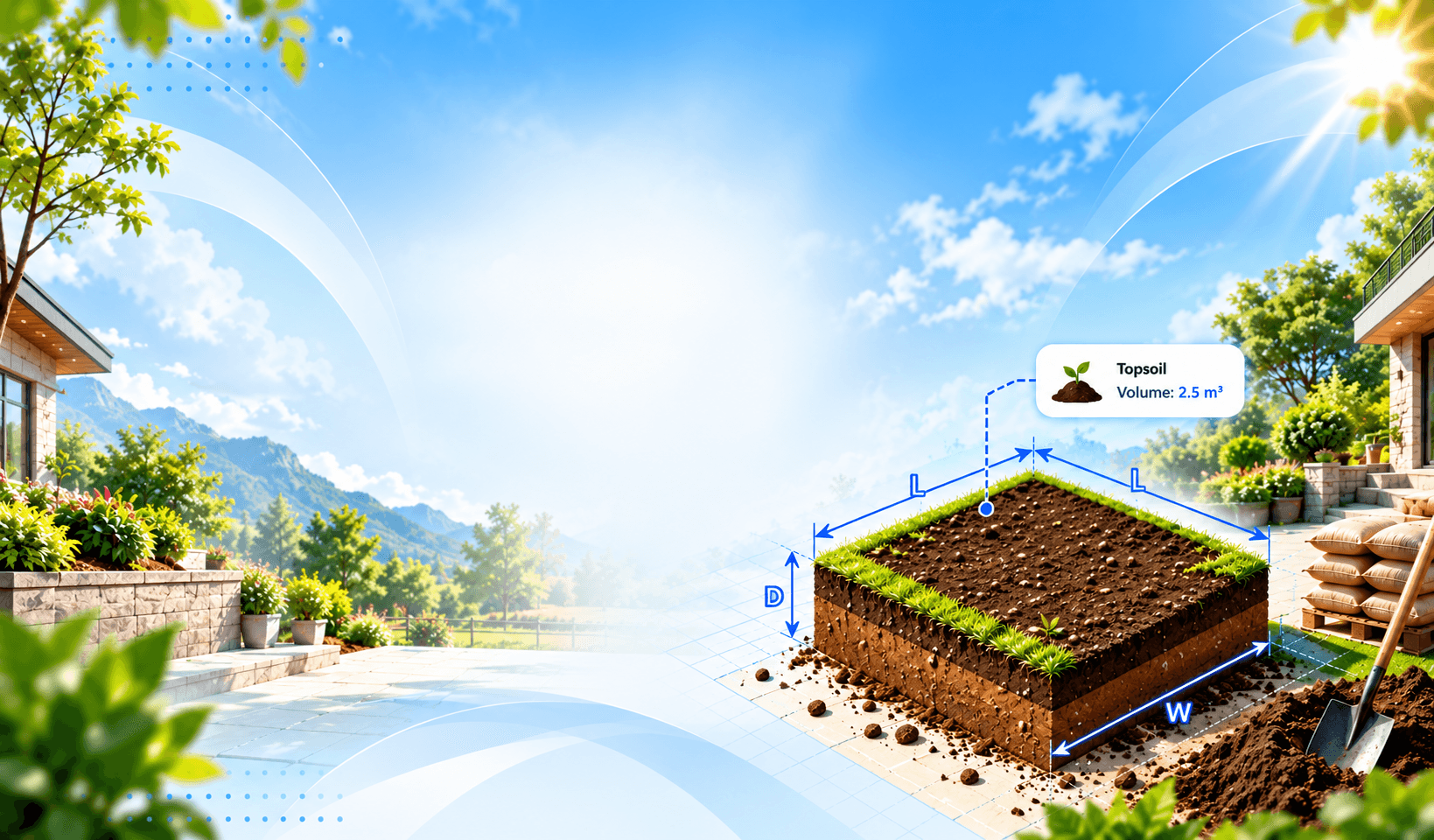
How to measure topsoil
Measure length and width for each rectangular area, then enter the planned soil depth. Split irregular projects into rectangles and add their results.
The same footprint-and-depth approach, including how to split an irregular area and choose a representative depth, is covered in more detail in How to Measure a Gravel Project.
Formula
Volume = length × width × depth
Bags = ceil(order volume ÷ bag volume)
Bag sizes and weight
There is no assumed bag size. Bag count appears only when you supply a positive volume in litres or cubic feet. Any weight remains an estimate tied to the visible density assumption.
Why weight is an estimate
Bulk density changes with moisture, organic matter, compaction, and source. Weight appears only after you choose a density or enter a custom value.
Worked example: Raised Bed Planting
A standard 10 ft × 8 ft garden bed excavated to a 6 in depth (0.5 ft) yields a raw volume of 40 ft³ (1.4815 yd³). Adding an editable 10% settling and compaction buffer results in a recommended order of 1.6296 yd³.
10 ft
3.05 m8 ft
2.44 m6 in
0.5 ft / 15 cm1.6296 yd³
+10% bufferHow 1.6296 yd³ translates into typical supplier purchase units:
Estimated Weight
at 2,200 lb/yd³
Standard Bags (0.75 ft³)
Small retail bags
Large Bags (1.0 ft³)
Landscape supply bags
Bulk topsoil vs bagged topsoil
For a garden bed, raised bed, or lawn, calculate soil volume first. The cubic-yard or cubic-metre result is the common starting point for bulk orders; bag count and estimated weight are alternative purchasing views derived from that same volume.
Bulk delivery
Use the cubic-yard or cubic-metre result when a supplier quotes by volume. If it quotes by weight, select a sourced density or enter the supplier’s product density and treat the result as an estimate.
Bagged Soil
Enable bag count and enter the exact volume printed on the package. The calculator rounds up to a whole bag; shortcut sizes are editable convenience values, not claims about every product.
Compare local availability, delivery limits, and product specifications directly. Formulexa does not assume a price or currency for this global calculator.
HELP & GUIDELINES
Topsoil calculator questions
Source context for density variability: USDA NRCS Soil Quality Indicators: Bulk Density.
How these calculators are built
- No Sign-UpUse every calculator instantly.
- Private by DefaultYour inputs stay on your device.
- Checked FormulasDocumented and tested methods.
- Visible Review DateSee when this page was last checked.